The City
A recurring series in Liminalities
Editor: Stuart Andrews (Brunel University of London)
stuart.andrews@brunel.ac.uk
A recurring series in Liminalities
Editor: Stuart Andrews (Brunel University of London)
stuart.andrews@brunel.ac.uk
Call for Papers & Projects
The City is an international series within Liminalities dedicated to advancing critical understandings of urban performance.
The series explores what performance — as method, practice, and mode of analysis — can reveal about urban environments, and how those environments in turn shape, inform, and challenge performance. We begin from the proposition that performance does not simply occur in cities; it participates in making, remaking, and understanding them, just as urban conditions can reconfigure what performance is and does.
By attending to specific places and practices — including embodied encounters, architectures, infrastructures, and civic processes — The City seeks to rethink how urban environments are made and remade, understood, negotiated, and contested, experienced, imagined, and transformed, and lived and worked through diverse performance practices.
We approach “cities” and “performance” expansively. We are interested in submissions that enquire into urban environments broadly conceived — including peripheries, informal and transitional spaces, infrastructures, digital representations, speculative futures, and planetary urbanisation. At the same time, we seek to extend and interrogate what constitutes performance in and of urban space.
Areas of Interest
We welcome research from any discipline that examines cities and urban performance, including:
- Artistic and aesthetic practices
- Everyday, social, civic, community, and activist practices
- Architecture, buildings, infrastructure, mapping, planning, and policy
- Urban responses to local and global challenges (e.g. climate crisis, migration, inequality, precarity, surveillance)
- Practice research and embedded creative methodologies
We are particularly interested in submissions that:
- Explore how urban environments are lived in, moved through, and continually remade
- Develop new methodological or conceptual approaches to the relationship between performance studies and architecture, design, geography, planning, urban studies, and related fields
- Demonstrate the specific contribution of performance to contemporary urban debates
- Consider cities as performed entities — not simply places where performance happens
Guiding Questions
The following prompts are offered as catalysts rather than limitations:
- How can performance studies generate new understandings of urban environments as text, infrastructure, territory, ecology, or lived condition in the twenty-first century?
- In what ways do theatre, performance, installation, and live art intervene in — or become entangled with — urban planning, cultural policy, civic identity, or spatial justice?
- What performances reveal obscured, forgotten, or contested urban histories, and with what political or cultural implications?
- How might performance open up alternative urban imaginaries or futures?
- How do urban environments themselves perform — through regulation, circulation, architecture, or governance — and how might such performances be analysed?
Formats
We encourage a wide range of scholarly and creative approaches, including:
- Theoretical essays and critical reflections
- Practice research projects (submitted with a practice research statement – see below)
- Book, performance, and project reviews
- Proposals for special issues or curated sections
There are no formal word limits; however, we recommend:
- Articles: 6000-8000 words
- Reviews: 800-1200 words
- Extended review essays (addressing multiple works): up to 3000 words
For 'practice research' submissions, we welcome formats that include image, video, or digital work, and/or documentation of exhibition or site-based work. Please include a 300-500 word practice research statement detailing:
- The research question or thesis
- Context and field
- Methodology or process
- The contribution or discoveries and their significance
While this statement may be written in a personal voice, it should clearly articulate the contribution of the work beyond the life or practice of the individual.
Please make consistent use of a style guide, as well as spelling conventions (e.g., British vs. American English), throughout the essay. We prefer MLA or Chicago style guides with footnotes, but accept and work with most other styles as well.
Submission & Contact
All submissions should include:
- An anonymised abstract (200-250 words, PDF)
- Fully referenced, anonymised original text. Use consistent style/spelling (MLA or Chicago with footnotes are preferred but not required) (PDF)
- Additional files as required (large files may be shared via secure link or file transfer)
- A short biographical statement (maximum 100 words)
- A permissions statement for all supplementary material (e.g. images), with evidence of permissions. Authors are responsible for securing all necessary permissions.
- An ethics statement identifying that appropriate institutional processes were followed in the development of the work.
- A statement reporting funding that supported this work
- A statement declaring any conflicts of interest
Review Process
Submissions are initially reviewed by the editor. Selected submissions are then sent for peer review. The review process typically takes approximately three months.
The City and Liminalities value anonymised peer review, while recognising that some creative or situated practices may not be fully anonymised. In cases where anonymity is not possible, peer review will still be employed in a way that maintains the anonymity of the reviewers. Liminalities recognizes the heightened ethical implications of such an asymmetrical situation. Reviewers may forego anonymity, regardless of a project's submission format, whenever they wish.
Publication
The City appears within Liminalities in the form of individual contributions, curated sections, or special issues of the Liminalities journal.
Copyright Statement/Creative Commons
Liminalities supports the Creative Commons project of alternative copyright, which allows authors to keep copyright while inviting certain uses of their work. Authors and artists maintain ownership of their work and allow Liminalities to publish it in various digital formats. We ask authors to acknowledge Liminalities in the event of any future publication of the same work. Unless stated otherwise on an individual work, everything on Liminalities is licensed by the designation below:

This work is licensed under a Creative Commons
Attribution-NonCommercial-ShareAlike 4.0 International License.
About the Editor
Stuart Andrews works at the intersection of performance, place, and resilience, exploring how creative practice helps organisations and place managers respond to complex challenges. He is Head of Theatre at Brunel University of London and Co-Director of the Performing City Resilience research project.
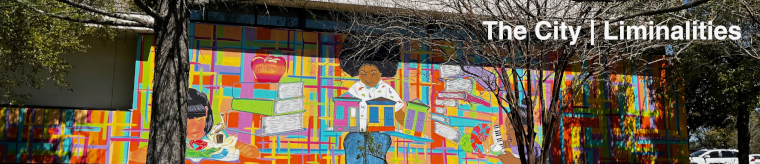
Banner Image: "Colors of Our Culture" (mural), 2022, East New Orleans Regional Library, 5641 Read Boulevard, New Orleans, Louisiana, by Journey Allen and the Young Artist Movement (YAM).
