
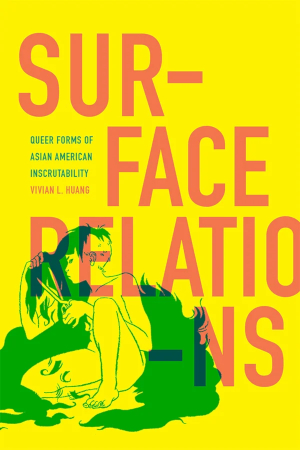
 To be inscrutable is to be marked as inaccessible, silent, flat, distant; it is to be a surface which both invites and refuses penetration. In Surface Relations: Queer Forms of Asian American Inscrutability, Vivian L. Huang theorizes inscrutability as an Asian American aesthetic and affect. Huang guides their readers through a historicization of inscrutability as an Orientalist trope before, with an abundance of care and generosity, inviting us to consider the worldmaking capacities enabled within the time and space of the inscrutable. Surface Relations offers a reparative theoretical framework that is in deep conversation with women of color feminism and queer of color performance studies. Expanding and paying homage to José Muñoz's trailblazing work in Disidentifications, Huang unspools the complex affects of disidentificatory worldmaking — silence, flatness, distance, (im)penetrability — to ask what happens when one steps into, rather than away from, the aesthetics of racialized harm. Offered at the other end of the tunnel: a glimpse of "the prospect of hope in the unknown" (23).
Through deft readings of poetry, photography, paintings, films, plays, and novels, Surface Relations develops "inscrutability" as an analytic tying together various majoritarian perspectives of Asian America: as model minority, as apolitical, as asocial, as parasitic. Following scholars such as Anne Anlin Cheng, Surface Relations is concerned with Asian Americanness not as an identitarian formation but as a mode of racialization and aestheticization. Huang traces the cultural history of Asian Americanness as "epistemological limit" (7) in realms ranging from critical theory to transnational capitalism, demonstrating how grammars of inscrutability underly both historical and contemporary forms of anti-Asian violence — particularly in the era of Covid-19. And yet, as Surface Relations repeatedly demonstrates, "to resign inscrutability only to a position of victimization is to concede too much" (21). Huang's framing question guides the trajectory of the text: "What if inscrutable modes make certain worlds more livable and even proliferate social possibilities?" (10)
Surface Relations opens with an Introduction which historicizes inscrutability as an Orientalizing discourse, focusing particularly on the foundational enmeshment of racial, sexual, and gendered Otherness in Asian American political and social relationality. Through a reading of performance artist Baseera Khan's Acoustic Sound Blankets, Huang engages with questions of racialized and sexualized excess and the minoritarian burden of liveness (in conversation with scholars such as José Muñoz, Tavia Nyong'o, Lilian G. Mengesha, and Lakshmi Padmanabhan) to ask how "Asian Americans present a different kind of problem than being 'too much alive' but rather not lively enough" (19).
Each of the chapters that follows closely examines a particular aesthetic of inscrutability. Chapter 1 examines Young Jean Lee's play Songs of the Dragon Flying to Heaven, Denise Uyehara's performance piece Hello (Sex) Kitty, Kimsooja's installation Archive of Mind, and Jess X. Snow's print I Will Never Stop Reaching for You to theorize about invisibility and vanishing points as forms of inscrutability. Intersecting with these analyses is Huang's astute discussion of the narrative trope of Asian femme death which enables white masculine self-actualization and reproduction. Consistent with their larger project of reclaiming forms of alienation and oppression as potentially generative of minoritarian relationality, Huang reparatively reads the all-too-common question of "Where are you from?" as a gesture towards a queer Muñozian utopia on the fringes of the here-and-now: "You did not come from only this, and you were not made for only this. You were made for a better world" (32).
Shifting from the visual to the aural, Chapter 2 focuses on silence, docility, and obligatory hospitality as aesthetics and affects of inscrutability. Huang reads performance and video works by Yoko Ono, Laurel Nakadate, and Emma Sulkowicz to suggest that obligatory hospitality — notions of Asian American women as inherently responsible for looking after the well-being of others — can be displaced and disidentified with. The result would not be a turn away from hospitality and caregiving but rather attention to "the pleasures of giving or saying yes" (53). Huang offers parasitism as the second pole in a dialectic with hospitality; they argue for "a feminist rendering of the parasite" (60) which does not moralize about the positions of host and parasite but rather attends to the complex emergent relationalities of such situations.
Jumping forward to Chapter 4, Huang offers us readings of artwork by Mika Tajima and New Humans which make a striking claim: that there are generative possibilities in reading Asian American aesthetics alongside modular office furniture. Building upon a theory of aesthetic "flatness," Huang develops ideas of "flat flexibility" and "slack labor" to argue that the figure of the Asian laborer — whether as model minority or migrant laborer — is characterized by a kind of modular flatness which resembles that of office furniture. Woven throughout the chapter are uses and discussions of psychoanalysis, from broad commentaries of the place of psychoanalysis in Asian American studies (through the work of scholars such as David Eng and Anne Anlin Cheng) to the instrumentalization of D. W. Winnicott's notion of destruction as reality testing. Tajima's artwork, which makes use of discarded office furniture and cubicle dividers, provides a foundation for Huang's virtuosic theory-crafting of flatness as a modality of inscrutability.
The final full chapter of Surface Relations examines the photography of Tseng Kwong Chi alongside the 2018 Harvard admissions lawsuit in which it was revealed that Asian American applicants were consistently given low marks in "positive personality." Huang explicates "the ardently relational work of performing distance" (135), both as an affective and a geographic notion. Through an examination of "Tseng's performance of communist drag" (149), Huang argues that the performance of distance in these photographs calls attention to otherwise invisible relationalities — particularly the often-racialized relationalities between human communities and land. They pay special attention to the phrase "SlutForArt," printed on Tseng's ID badge in many of his photographs, and how it highlights the erotics of aesthetic relationality — what Huang calls "queer coordination" (160) — manifested within these photos.
Surface Relation's conclusion examines the inscrutability of Tehching Hsieh's performance art and its documentary practices. This discussion returns us to Huang's core definitional conceit of Asian American aesthetics of inscrutability as non-identitarian, particularly in how meaning is located in the relational matrix between artists and audiences rather than within any static identity categories. Surface Relations concludes with a final Muñozian gesture: "discourses of inscrutability constitute ephemera of relationality" (180). We arrive back at the temporal, the performative, and the timespace of minoritarian worldmaking.
The theoretical rigor Huang brings to this text would be enough to justify its worth on its own. And yet, what is most striking about Surface Relations is not its admirable theoretical offerings, nor its critical curatorial labor, nor its ability to speak across a wide range of disciplines. This text's own ephemera of relationality is the care Huang offers to their readers, their students, their mentors, and their broader networks throughout the book. Huang performs "imaginative worlds of support and care" (56). These worlds are performed not in the meaning of "performative" that inheres in much contemporary leftist activist thought, wherein performativity is delinked from material engagement — a mode which Huang themself critiques in how it demands visibility and intelligibility. Instead, they are performative in the sense of an embodied enactment which does things in the world, bringing into being emergent affective and political communities. Throughout the text Huang repeatedly acknowledges moments in which they learned from their students and the networks of mentoring and support which enabled this book to come into being. They orient this book towards their students "who are working toward world-making in a reality that speaks in identity politics that often do not include them" (22). The text is filled with invitations — this is not a book that demands that readers "correctly" understand the authorial argument but rather one which extends opportunities for engagement, offering contrasting readings from varying perspectives and support for readers in moments of discomfort.
Chapter 3 is exemplary of this ethics of care. Discussing the novels Fierce Femmes and Notorious Liars by Kai Cheng Thom, The Book of Salt by Monique Truong, and For Today I am a Boy by Kim Fu, Huang turns their attention towards questions of (im)penetrability. Yet again, the purpose of this chapter is to offer a reparative reading which not only critiques majoritarian understandings of Asian American femmes (particularly trans women) as simultaneously epistemologically impenetrable and sexually penetrable, but also reclaims penetration as a generative and pleasurable minoritarian aesthetic. The content of the chapter is difficult to say the least. Huang discusses the place of rape and self-injury, particularly cutting, within these three novels, but does so with care and kindness. They inform readers of the content they will be encountering; they check in regularly to offer presence and support; and they perform a kind of aftercare in a turn away from injury and trauma and towards good, cathartic sex at the end of the chapter. The theory put forward — that cutting is "a literary pattern with as-yet-undetermined material stakes worthy of attention" (80) — is as fascinating as it is challenging, and Huang laudably pays as much attention to the context of their readers' experience as to the argument itself.
Surface Relations is a remarkable text which has much to offer scholars in performance studies, Asian American studies, queer of color theory, and literary studies. To read Surface Relations is to step into a timespace of generative unintelligibility, of care beyond language, and of just-out-of-reach utopias in the making.
— Reviewed by Nic Vigilante, Cornell University
Nic Vigilante (they/them) is a PhD Candidate in Music & Sound Studies and Don M. Randel Fellow at Cornell University, where they are also affiliated with the Media Studies and Feminist, Gender & Sexuality Studies programs. They teach and publish on topics including ethnographic and digital humanities methods, queer Asian American nightlife, music and video games, and sonic violence. Nic was a member of the inaugural cohort of Mellon/ACLS Dissertation Innovation Fellows in 2023, and their work has been recognized with awards from the Society for Ethnomusicology, the Canadian Society for Digital Humanities, and the American Studies Association. Their recent and forthcoming publications can be read in Women & Music, The Oxford Handbook of Online Music Cultures, The Journal of Extreme Anthropology, and Gender and Sexuality in Video Game Sound (Routledge).



