
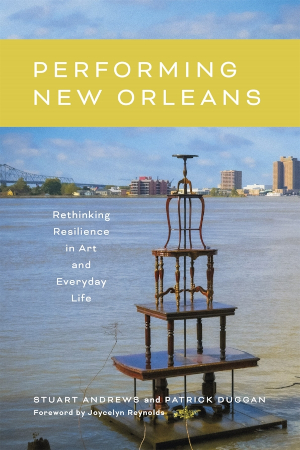
 In Performing New Orleans: Rethinking Resilience in Art and Everyday Life (2025), co-authors Stuart Andrews and Patrick Duggan approach the city of New Orleans, or Bulbancha, through twinned lenses of performance and resilience. The two authors are long-time collaborators, and co-directors of the project Performing City Resilience, whose work aims to address 'real-world challenges through performance research'. In this lucid and diligent volume, the scholars chart their explorations of performance in New Orleans, applying consistent critical care to navigate a reconsideration of typical framings of the city and its character. Early in the introduction, the two authors describe their research “hunch” (after Baz Kershaw), that performance theory and practice might be essential tools with which to approach a much-needed re-evaluation of New Orleans (p. 3). It is evident as the book progresses that this “hunch” is warranted, and that the wealth and vitality of the city's performance cultures bear striking relevance in understandings of resilience and crisis, locally but also beyond the city itself.
Andrews and Duggan divide the volume into five chapters, approaching key elements and settings of the performed city. They begin with New Orleans' complex relationship with tourism and overtourism, fittingly contextualising their own engagement as visiting academics with a city often experienced within the restrictive format of a long weekend. The out- and indoor sites of performance with relation to crisis are next explored in turn, as a chapter on performance in the streets of New Orleans is followed by an analysis of 'situation rooms' in the city. The authors take a broad approach to this term, from the literal situation rooms in which town planners anticipate and stage potential crises, to the community and arts venues in which the city is rehearsed and presented back to itself. New Orleans' negotiations with its spatial and historical location round out the volume. A fourth chapter focuses on the city's equivocal relationship with the water which moves through it, and includes particularly moving discussions of installation and performance art pieces such as Jennifer Odem's Rising Tables (2017). Finally, the volume's attention turns to New Orleans' responses to moments of acute and chronic crisis, in particular the Covid-19 pandemic, as the authors insightfully challenge existing models of crisis management.
A key concept the book advances is that of an arts-resilience approach, which the authors reflect might not a be familiar one. This approach advocates for a recognition that the work undertaken by artists and cultural practitioners engages meaningfully with the major challenges facing their localities and communities. Those creating arts and culture in New Orleans, Andrews and Duggan argue, are already undertaking vital work towards resilience where they live; it is the authors' intention to 'reveal and demonstrate' the value of such work (p. 3). As such, this volume strikingly emphasises the ways in which performance and culture are typically underestimated and misconstrued, but reading it is not, as one might expect, disheartening. Instead, I came away from the book invigorated and compelled by the extraordinary potential of the arts to prepare, respond, metabolise, imagine, and challenge in the context of crisis.
Throughout, the text takes a generous approach to readers without prior knowledge of New Orleans, narrating its authors' exploration of and developing familiarity with the city with an involving curiosity. Andrews and Duggan do, however, take multiple opportunities to set records straight regarding what the city is and is not. One pernicious idea with which they take particular issue is that New Orleans is especially resilient. Such an assumption reduces the city to an exceptional place of catastrophe rather than a city of ordinary people. More importantly, it risks shallowly valorising its residents for surviving precarity while refusing to attend to the factors which render them precarious. Nor is New Orleans a 24/7 party, or a city whose character can be captured during a three-day visit and a checklist of must-see spots. New Orleans is far better understood and attended to, the authors suggest, through engagement with its artistic and cultural processes and creations. Andrews and Duggan dedicate pages to the recognition of their research collaborators and the organisations and individuals who welcomed them into the city. They quote Cherice Harrison-Nelson's assertion that New Orleans' cultural practitioners are 'spiritual first responders'; a connection drawn between artists and crisis which will stay with me long past reading (p. 161).
In the final lagniappe (or little something extra) to this rich and thought provoking volume, Andrews and Duggan resist an assertion that performance in New Orleans has been theorised 'enough'. They argue that on the contrary, the city's performance cultures have not yet been taken seriously enough in the ongoing urgent conversations about the crises and challenges facing this and other cities today. This text contributes a vital effort towards necessary and renewed ways of seeing New Orleans, performance, and resilience.
— Reviewed by Leila Nashef, University of the Highlands and Islands Inverness
Leila Nashef is a playwright, performer, and academic. She works as a lecturer at the University of the Highlands and Islands in Inverness, Scotland. Her recently concluded doctoral research, entitled 'Enacting Trauma: a creative and critical exploration of the ethical implications of staging the traumatic', focused on the experiences of spectators in contemporary British theatre which stages traumatic events or experiences.



