
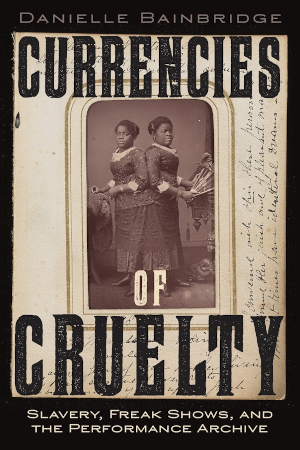
 Danielle Bainbridge's Currencies of Cruelty is a captivating work of scholarship. Aptly so, as the book centers on the archival material of nineteenth-century freak show performers—particularly, the life of Millie-Christine McKoy, enslaved twins famed for their conjoined lower-body. While slave labor has been traditionally understood via the manual labor of field hands and house slaves, Bainbridge challenges this dominant narrative, which assumes Black bodies with congenital disabilities are “useless” in the creation of products and “valueless” to the cultivation of domestic life on the plantation (45). For this reason, Bainbridge claims their labor has been routinely overlooked not only by documentarians of their time, but also by scholars in modernity.
While it is important to recognize the ableist structure of chattel slavery, Currencies of Cruelty does an exceptional job at reading for disabled commodification in the plantation economy; the Black disabled body operates as both the site of labor and the consumptive product. A theory Bainbridge substantiates by pointing to archival evidence of those with congenital disabilities becoming “objects of spectatorship” (15) via “a process of enfreakment (or being made freakish through a nexus of disability, racialization, and marginalization)” (ix). Disabled enslaved labor was routinely documented in the "playbills, visiting cards, newspapers, autopsy report, reviews, photographs” of freak shows as opposed to the “plantation account books or bills of sale”(14). Thus, Black disabled bodies “actually held the potential to be high earners precisely because they were disabled” (45).
What makes Currencies of Cruelty a unique piece of scholarship is that Bainbridge's examination of freak show archives does more than merely highlight the existence of Black disabled labor throughout chattel slavery. Just as Black enfreaked labor is routinely overlooked by scholars, Bainbridge posits that so are the ways disabled bodies navigated fugitivity. Particularly because self-sovereignty could not look the same as their able-bodied peers; “for many disabled people, entering sideshow and freak show performances in the nineteenth century was the most viable way of earning a living and maintaining their independence” (48). Therefore, if “the act of historical preservation carries within it its own desire for futurity through conservation and continuation” (x-xi), then these performance archives must be read both as a curation of enslavers' desire for how the enfreaked would exist in collective memory and as showcasing the complex desire for how the enslaved wished to be remembered.
Inspired by “other speculative approaches and grammatical approaches to history” which call the authority of the archive into question (5), Bainbridge considers how freak show archives are a complex negotiation which requires more than “simply accounting for the uncertainty of the conditional past tense (or 'what could have been')” (17). Instead, the enfreaked performance archive must also be read as “deeply invested in the unknown and unsettled past tense of the future (or 'what will have been')” (17). Bainbridge coins this anticipatory performance of “what will have been,” the “archival future perfect” (26). A concept she further fleshes with throughout the book's four chapters.
In the first chapter, Bainbridge examines the duality of the performance archive of Millie-Christine McKoy. Although their disability began as a lucrative spectacle for enslavers, Bainbridge considers the McKoys' decision to perform post-emancipation under the same rates established while in bondage. Archival evidence of this self-appraisal is important for two-fold reasons. First, it showcases the future-perfect by highlighting the performance archive as operating “both in the future of the McKoys as independently wealthy stage performers and in their past as enslaved laborers” (24). Secondly, it evidences “systems of accounting that consider the fiscal value and worth of enslaved and disabled performers through the lens of slavery but do not rely entirely on the traditional bookkeeping of enslavers” (25).
While Millie-Christine McKoy's performances remained fiscally consistent pre-and-post emancipation, an important thread throughout Currencies of Cruelty is how their performances altered in content. Originally, the McKoys' performances centered around “their shared genitals and reproductive organs and presumed infertility” (44). However, throughout their time as freed performers, Millie-Christine refused to be seen naked. In fact, the McKoys insisted on keeping their bodies from view even after death. Chapter three explores the repeated articulation of what they wish done with their bodily remains; another expression of the future-perfect archive, wherein the twins articulated in the past exactly how they hoped to be remembered in perpetuity. Bainbridge focuses on their expressed fear of being autopsied, as public autopsies and scientific preservation of enfreaked corpses were common throughout the nineteenth and early-twentieth century. Not only were these autopsies a way Black enfreaked bodies were made to perform after death, but often these autopsies defiled their bodies (ex. the circulation of Sarah Baartman's genitalia postmortem) or sought to demystify the performance identities painstakingly cultivated during their lives (ex. Joice Heth's real age being debunked in a public autopsy).
In the case of Millie-Christine McKoy, the twins centered their performances around skills of the mind (such as their ability to hold discrete conversations in different languages, simultaneous recitations of literature, and musical accompaniment to each other). Bainbridge considers how this emphasis on skills situated from the waist-up was meant to redirect attention from their shared genitalia. Though it is undeniable that the desire to examine their conjoined bodies drove such large crowds to their shows, when in control of the performances, the McKoys found ways to make a living without making a spectacle of their disability. Self-sovereignty was reinscribed through the showcasing of improvisational musical/oral virtuosity in place of visuality. Invoking what Bainbridge refers to as an “aural fugitivity” into their enfreaked performances (124).
Despite their penchant for improvisation being archivally documented, the improvisation and sounds themselves could not be captured. As a result, the McKoys' “aural fugitivity” remains gaps in the archive for today's historians and theorists. Chapter four focuses on Bainbridge's own attempts to account for the oral and musical riffs absent in the McKoys' archive. Here, Bainbridge deploys Saidiya Hartman's concept of “critical fabulation”; an interstitial space of theorizing between compromised fact and unsubstantiated speculation. Turning to poetry collections—m. nourbeSe philip's Zong! and Tyehimba Jess' Olio—that engage with enslaved archives, Bainbridge considers how these works operate as models for critical fabulation in praxis. Here, she offers a particularly fruitful reading of Jess' invocation of the McKoys throughout Olio. While generous in her praise of Jess' focus on the twins' inner thoughts and lives (as opposed to their enfreaked bodies), Bainbridge does not shy away from critiquing how Jess' “syncopated sonnets”—which are meant to offer readings that both isolate the voice of Millie, isolate the voice of Christine, and collapse them into one unified voice—fail to adequately individuate the women. Rather than creating two discrete voices that work in tandem, “there is no distinct discourse from one sister versus another” (157-158). Learning from these models, Bainbridge proceeds to roadmap the assemblage of her own performance piece, Curio, a dramatic performance of the McKoys' archive.
It is impressive how Bainbridge manages to gesture at the aural-fugitivity of the McKoys' performances without overwriting archival gaps. For example, rather than attempting to recreate the soundscape of the McKoys' shows (most notably, adhering to evidence that Millie-Christine played the guitar and piano), Bainbridge chooses to have actors in Curio play handbells. While she notes a plethora of reasons for this substitution, her citing Fredrick Douglass' autobiography presents a particularly compelling case. Specifically, the passage where Douglass refuses to narrate how he escaped his plantation; he claims the disclosure would only enlighten enslavers on the inner mechanisms of Black fugitivity, while simultaneously shuttering a crucial route of escape for his brethren still in bondage. Bainbridge notes how “this deliberate obfuscation” and “sonic refusal” is a way in which Douglass acknowledges his mostly white readership (161). Even as his autobiography was scribed in service of Black unfree bodies, his work is still a commodity for curious white eyes. Therefore, when discussing paths to freedom, it is crucial that “[h]e gives us evidence of its existence, even while he withholds the details. His intentional silence rings out” (162). In the same vein, Bainbridge is equally cognizant of her role as a Black scholar working within, receiving financial support from, and being published by predominantly white institutions. In Curio, handbells are an act of sonic refusal; a way to simultaneously hint at and preserve the McKoys' aural fugitivity. But even in the conclusion, Bainbridge continues to question, elucidate, and critique her engagement with the McKoy archive. This deep concern for the dead makes Currencies of Cruelty a truly gorgeous model of scholarship.
Personally, I am excited for what possibilities may emerge from Bainbridge's marriage of concurrent conversations in Black, disabled, and performance studies. For example, the transformation of the McKoys' performances from a grotesque fascination with their “presumed infertility” to a celebration of their creative abilities is reminiscent of Reginé M. Jean-Charles' definition of the “ethical-erotic”; a concept which reframes eroticism as not only linked to sexual reproduction, but also an artistic sensuality which begets creative output. In future scholarship, I would be curious to see how the McKoys' enfreaked performances might be combined with Jean-Charles reframing of erotic encounters to gesture at new readings of “reproductive enumeration" in Black enfreaked archives (35). Rather than only centering questions of (in)fertility around individuals who could bear child-commodities, such discussions may expand to include those enfreaked bodies whose creative reproduction was also employed for/against the plantation economy.
At first glance, Bainbridge's call to view the archive itself as a performance of the past, by the past may appear synonymous with previous projects (ie. “critical fabulation”) preoccupied with records deliberately (dis)included by enslavers. But when the “future perfect archival tense” is applied to the desires of the enslaved (27), I find it to be a groundbreaking ethical claim. By refusing to focus solely on how enslavers shaped the archive, Bainbridge keeps their hands from molding her research. Instead she prioritizes the desires of the enslaved, enfreaked, and too-long overlooked. Currencies of Cruelty can be read as lamentation of violence and celebration of ingenuity. But above all, it ought to be read as provocation. A call to begin every archival project by asking: how did my subject imagine my engagement with their legacy?
— Reviewed by Boatemaa Agyeman-Mensah, University of Virginia
Boatemaa Adoawaa Han Mee Agyeman-Mensah is a GhanaianKoreanAmerican poet from Ham Lake, Minnesota. Her writing has appeared in American Academy of Poets, BRINK, CALLALOO, Carolina Quarterly, Cellar Door, COUNTERCLOCK Journal, and Meridian, and has been recognized by the Adroit Journal. In 2024, she was an Ignite Rural Fellow. From 2022-25 she served as co-director of COUNTERCLOCK x PATCHWORK, an interdisciplinary poetry-film collaborative fellowship. Currently, Boatemaa is an MFA candidate at the University of Virginia - Charlottesville.



