 |
You mock me You greet me You taunt me You mold me Rust Crum ble Rust Loc k Rust Ja m Rust Tower Rust O pen Rust GlorY Rust Base Un weeded Un watered Un welcome Un wavering Thank you for the reminder the welcome and the release. |
 |
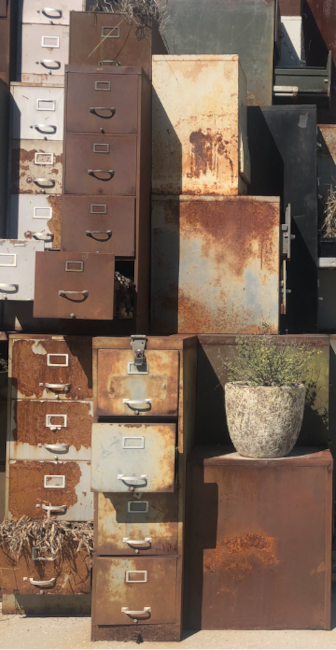
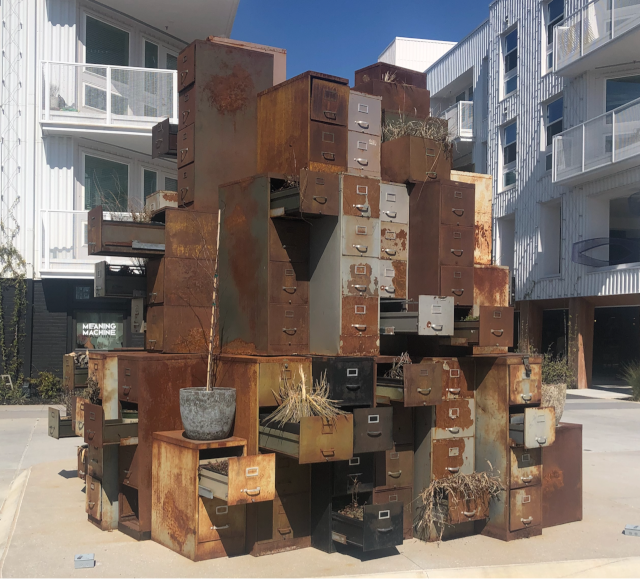
A sculpted tower of rusted filing cabinets sits at the entrance of Atlanta's Goat Farm Arts Center. The rust is surprising, alive, deep in corroding color, faint and bold patchwork patterns, uneven abundant shades of orange, brown, copper on the cabinets, themselves also surprising as they shoot up, suggesting a glorious plan that might have been, an absolute explosion of industry, now an assiduous archive rendered into obscurity, irretrievability, obsolescence, hubris.
Cabinets are every shade of green, gray, brown, beige, and maybe silver. Some drawers are open, others locked, most closed shut. Tall grass, chunks of straw, and the remnants of carefully selected ferns and ivies fill open ones. Clamoring to rise to the top, or burst out horizontally, the drawers no longer live with a starting point or chronology. A few drawer labels are legible. 1958 1959 PURCHASE INVOICES Two or three potted plants are arranged around and on top of the tower. Installed for The Goat Farm's reopening in 2024, the filing cabinets lived an earlier life inside industrial buildings scattered across the sprawling 19th century complex, once a manufacturing center for cotton milling equipment, and later WWII munitions. The project — Untitled Ziggurat (2014-2024) — by David Baerwalde was first assembled as a massive wall outside a Goat Farm warehouse building in 2014. That year, I walked by it during an experimental art event and paused to take two sheets of paper out of my backpack. I jammed an edge of one sheet into the seam of a closed file drawer. The other I curled up like a tube, and slipped into a handle. I then continued walking. Out of the corner of my eye, I noticed agitation among a few people sitting nearby, perhaps the artist and friends. One stood up and removed my additions. Had I disrupted the installation? Or had they? |
Baerwalde's reinstalled work greeted me again multiple times this year, as I visited The Goat Farm for work, dance performances, art shows, and cabarets. Vertical Jam / Temple of Disheveled Archives is my response, a tribute poem, in honor and fear of the massive tower.
In other work, Kwame Phillips and I have written about "the problem of the ethnographic archive [as] a problem about anthropological modes-of-being" (2020:67). Both anthropology and archives are shot through with existential questions and paradoxes around relations, responsibilities, and relevance. My research archive, probably like those of many anthropologists, is plagued and blessed by an impulse to stabilize and catalog ephemerality. So I read Baerwalde's towering project as a monument to, mockery of, and release from, this kind of impulse. And against the apparent coherence of a filing system, labeled drawers, and imprisonment in metal, I imagine Untitled Ziggurat's cabinets, drawers, rust, dying plants, and any possible remaining documents attesting to transactions about WWII weaponry to be just as haunted as anthropological archives, themselves pulled in various directions with "varying velocities, vibrations, agencies, wills, intents, memories, and so on" (69). To signal this vibrancy, Phillips and I offer the phrase "multi-inhabited" (67), pointing to a portal shaped less by a sense of haunting and trepidation, and more by feelings of wonder and reverence. Thus the temple.
It is a beautiful tower. I join it with the unfinished and abandoned business in my own disheveled archives. They too echo with unsettled relationality and curiosity towards becoming repurposed.
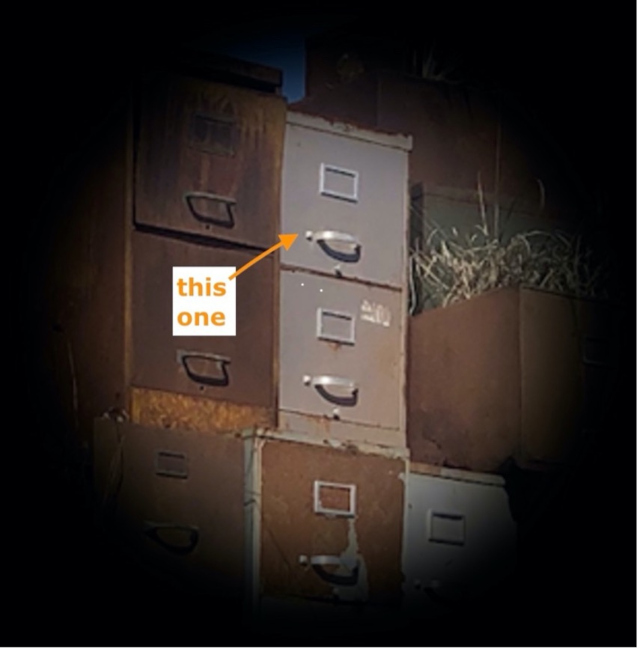
I went back to the tower yesterday. I noticed that one drawer was not covered in rust. I climbed up and pulled on its handle. It rolled open. Smoothly. Inside was just one folder. Crisp, clean, and labeled in thick black marker: Discussion Questions. I looked around. No one was watching. I took out the folder. I opened it. One clean white sheet of paper was inside. Here's what it said:
Discussion Questions (for self or group):
1. Would it matter if the other drawers of Baerwalde's installation were not locked or jammed shut?
2. Are any old documents inside the drawers?
3. What information about WWII weaponry production do you think is/was in the filing cabinets?
4. Vidali's father worked on a scrap yard that his grandfather founded in the 1930s. Vidali's father told her: "During the war years, I remember paper drives and railroad car loads of tin and steel. I was proud that my father and uncles were helping the war effort. I imagined bullets and tanks being made from the scrap that left our family's scrap yard business." This family business was over 900 miles north of the filing cabinets in Untitled Ziggurat. Is there a connection? Discuss.
5. What tower do you want to build?
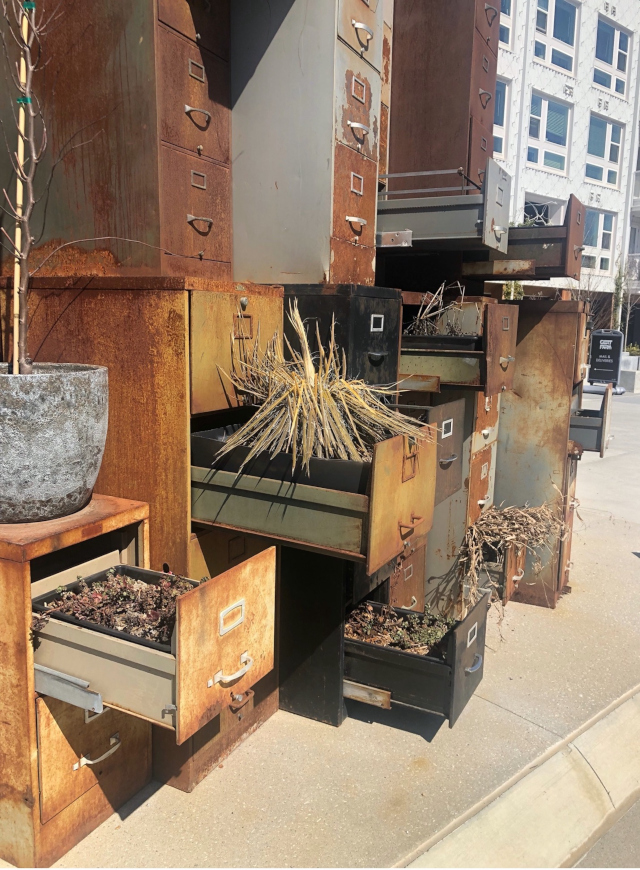
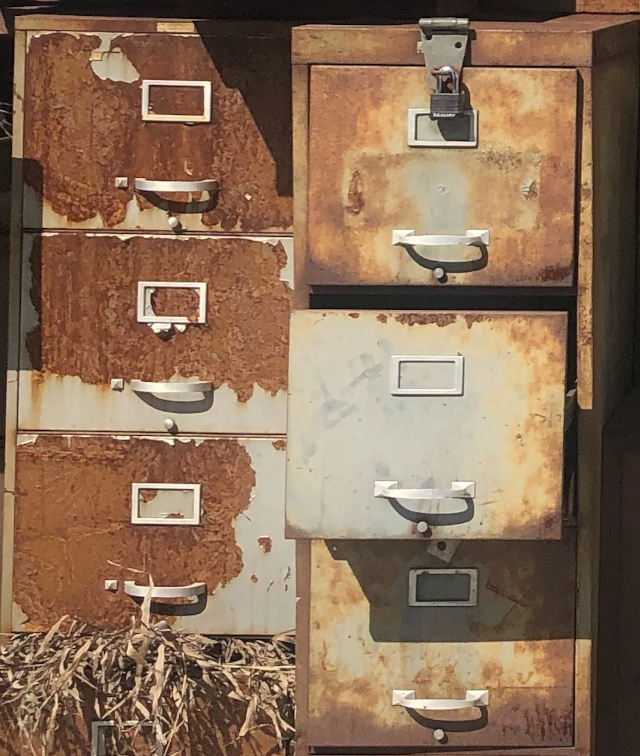
Image Credits
Photographs by Debra Vidali
Reference
Vidali, Debra and Kwame Phillips. 2020. Ethnographic Installation and “the Archive”: Haunted Relations and Relocations. Visual Anthropology Review 36(1):64-89. DOI: 10.1111/var.12197

