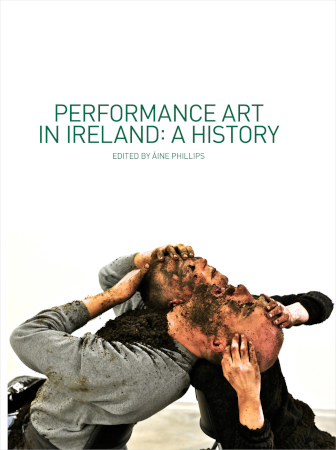
 Performance Art in Ireland, edited by Aine Phillips, came out in 2015 and remains an important text; no other recent work focuses solely on Live Art and performance in Ireland since the 1970s. With well-written prose and engaging images, Phillips' book is filled with recoveries of recent history and helpful practical advice for emerging artists. Any scholar or educator interested in Irish theatre and performance would do well to add this text to more recent works like Nicholas Grene's 2024 Irish Theatre in the Twenty-First Century and Emer O'Toole's 2023 Contemporary Irish Theatre and Social Change. Phillips tells a story still relevant and under-researched today, the Irish expressions of Performance Art of the forty-plus years between 1970 and 2015.
Phillips explains her goal in the Introduction: "examine work where the artist's body is the site of meaning, the primary material and the aesthetic substance; where there is corporeal presence and a relationship with audiences and context, be that site or subject matter" (7). Phillips is clear without sacrificing complexity here, and her Introduction explains a focus on "the island as a whole" because "the work of performance operates beyond perimeters" (8). She defines her terms and discusses the issues in this written and visual collection of Live Art and performance. At the end of the Introduction, a "Special Profile: Nigel Rolfe and Alastair MacLennan" section covers the history of these two performance artists and teachers, centering their work in these ongoing conversations. The strength of this volume is twofold: the contributors historicize and contextualize forms of art that are in dire need of scholarly and public discussion, and they do so in prose that reaches both academic and general readers. The difficulty in reviewing this groundbreaking work resisting the temptation to detail every Live Art example; below I note those that impacted me in the retelling, but I encourage readers to reflect on the entire text.
The first chapter, "Performing Political Acts: Performance Art in Northern Ireland: Ritual, Catharsis, and Transformation" by Andre Stitt explores the way that "a generation of emerging artists felt an inability to adequately confront daily violence through . . . traditional means of portrayal and exposition", arguing that in the North of the 1970s, forms of Live Art created communication and community. He discusses Scottish artist and teacher Alastair MacLennan's arrival in 1975 in Belfast, and MacLennan's focus on transformative art and ritual "blurring . . . binary distinctions that reflect interior/external, subjective/objective, and ultimately in Northern Ireland: sectarian division" (75). Stitt includes his own experience with graffiti art in this period "and the physical and psychic environment of Belfast in 1978" (77). In 2000, performing his Conviction, Stitt tarred and feathered his head and crawled from his childhood home to a pub on the other side of the city as a way to negotiate "divided territory on hands and knees as a ritual act of penance" (87). Reflecting on the physical pain of his own work and the real danger of MacLennan's Live Art, the risk to himself in public performance at that time, and the creation of community, Stitt recovers central stories to the history of Northern Irish performance art as a way to recovery from trauma. Firsthand accounts like this one are invaluable throughout the text, bringing the reader into the actual remembered experience of the artist.
Karine Talec's history of "Bbeyond" in the second chapter, "Bbeyond and the Art of Participation" argues that the BBeyond organization of performance artists brought international ideas and a sense of community to Northern Irish performanceart n the mid-1970s. With Bbeyond's manifesto from 2001 published and full and memories of the monthly meetings and ensuing public performances as well as striking photographs documenting these Live Art moments, Talec covers both the history and ongoing work of Bbeyond and the group's goal to "provide support and opportunities to local and international artists, building an ever stronger artistic network (web) that extends beyond the confines of style, identity, culture, and place (104).
Amanda Coogan's Dublin and Performance Art, Twenty Years of Action 1970-1990 begins with Brian O'Doherty's November 1972 Name Change performance of transformation of O'Doherty becoming PATRICK IRELAND at the Irish Exhibition of Living Art in Dublin's Project Arts Centre. This Live Art moment is for Coogan a starting place of this twenty year history as "it posits live performance as ephemeral, indelible, and irreplaceable action" (107). She describes moments of performance in this twenty year period with detail and clarity and discusses reviews and contemporary response, and she contends that "performance art is a time-based art form but not a time-dependent one. The performances considered here exist beyond the time of their presentation. . . The live performances made by and on the artists' bodies and witnessed in Dublin during this period were potent, were visceral, were vital, and are nodes of inspiration and influence for this generation (120). Her documentation of these performances proves her final argument.
A third chapter is a 2014 interview between Megs Morley and Danny McCarthy entitled "The Development of Performance and Sound Art in Cork" and includes important items from McCarthy's archive. In the early 1970s, McCarthy founded, with Patrick McQuoid, Triskel Arts Centre in Cork and his visits and collaborations with Belfast performance artists like Alastair McLennan. In this interview, McCarthy recalls performances, reviews, artists he'd worked with and known, and the importance of conversation around controversial issues like abortion, panel discussions, and print magazine reviews to creating an audience for the art. Morley ends the conversation with a reflection on re-listening and the sound of gulls over the recording that neither of them had heard at the time, and what gets missed and then remembered.
EL Putnam's "Polyphonic Resonance: Sound Art in Ireland" brings the history of sound and Live Art to the page and succeeds in representing this aural history in writing; again, this book's ability to bring performance and sound to the page is remarkable. In "The Development of Irish Feminist Performance Art in the 1980s and Early 1990s," Kate Antosic-Parsons examines the history of feminist performance art as a response to the conservative climate and gender inequalities in Ireland in the 1980s. She traces how these performances were "a feminist strategy to question essentialist and monolithic constructions of the 'Irish woman', whilst responding to the political and social realities of women's lives" (175). Antosic-Parsons examines the work of Alanna O'Kelly, Pauline Cummins, and Mary Duffy in particular, and these women's focus on the body in their anti-patriarchal performance art. Police dragging women, half naked, away, in the case of Mary Kelly and her performance in England, for example, and the chapter includes Kelly's firsthand account. With too many fascinating and alarming examples of the tension between bodies and sites of power to list here, Antosic-Parsons ends the chapter with performance art as a "legitimizing critique that unites art and feminist action" (205). Helena Walsh's "Developing Dialogues: Live Art and Femininity and Post-Conflict Ireland" reviews specific performances by female live artists that "enable a countering of cultural constructions of femininity in an Irish context" with questioning and subverting expectations (209).
The last four sections, Michelle Browns's "Performance Art in Ireland in the New Millenium" (an overview of performance in the South of Ireland since 2000) , Fergus Byrne's "Fragments on the Performance Collective: Subject to Ongoing Change" (a review of a group performance exhibition at the Galway Arts Centre in 2012), Cliodha Shaffrey's "Right Here Right Now" (a discussion of 19 performance artists simultaneously performing at Dublin's Kilmainham Gaol in 2010), and Aine Phillips' "Out of Ireland" (an argument for the importance of international Irish performance artists who live away from Ireland) bring the book into recent decades and make the concerns of the early chapters current. A "Timeline of Performance Art in Ireland" provides the reader with a helpful timeline and contributes to a valuable history of these art forms.
This text has much to offer for those interested in performance art, Irish history and literature, and the intersection between politics, activism, and art. My only very minor quibble is that I found the Table of Contents, though beautifully arranged, hard to follow. That criticism is minor though. Students of Irish history and performance, general readers, scholars, and, above all, emerging artists will benefit from this well-written and engaging history. What strikes this reader is the readability of the volume while maintaining nuance in discussions of these performances and the complexities of history.
— Reviewed by Elizabeth Brewer Redwine, Seton Hall University
Performance Art in Ireland: A History
Edited by Aine Phillips
[ Intellect, 2015 | 288 pages | 32 color plates, 100 halftones ]
Elizabeth Brewer Redwine Elizabeth Brewer Redwine is the author of Gender, Performance and Authorship at the Abbey Theatre (Oxford UP 2021) and Sara Allgood's Memories: Untold Stories of the Abbey Theatre and Early Hollywood (Oxford UP 2025) and co-editor, with Amrita Ghosh, of Yeats and Tagore: A Postcolonial Re-envisioning (Brill 2022). She teaches as a Senior Lecturer at Seton Hall University in the English Department and runs the first year Core course.

